
The Whole-Risk Blind Spot in an AI-Enabled Business

The most dangerous risk in business is not the one on the risk register.
It is the risk assembling between registers- across people, systems, data, permissions, suppliers, informal workarounds, AI tools, inboxes, decisions and silence.
Boards are often waiting for the numbers—the revenue decline, the breach notification, the employment claim, the whistleblower, the insurer’s reservation of rights, the customer loss or the regulator’s letter. By then, the organisation is not discovering a problem. It is paying for one that has been growing in plain sight.

This is the hard truth of the AI-enablement era: technology is accelerating the organisation faster than its leaders can see it.
Accenture found the rate of change affecting businesses rose 183% between 2019 and 2023, while 52% of executives did not feel fully prepared for the change ahead. Technology disruption became the leading driver of business change. Yet only 9% of organisations had built a capability for continuous reinvention. Accenture
That gap is where organisations break.
AI does not simply automate work. It multiplies decision speed, information movement, customer interaction, code creation, data access and operational complexity. It can expose weaknesses already buried in legacy systems and informal practice—then propagate them at machine speed. A weak approval pathway becomes automated. Poor data classification becomes AI-accessible. A manager’s untested judgement becomes a workflow rule. An over-permissioned account becomes an agentic access problem. A cultural reluctance to speak becomes a silence system just when the organisation needs early warning most.
The board may see an AI roadmap. It may not see the fragile reality underneath it.
The risk is already converging
Fraud, cyber compromise, misconduct, privacy failure, toxic culture, role-confusion, supplier manipulation and governance breakdown are no longer neat categories. They are different expressions of the same underlying exposure: the organisation cannot reliably see how work, authority, evidence and decisions actually move.
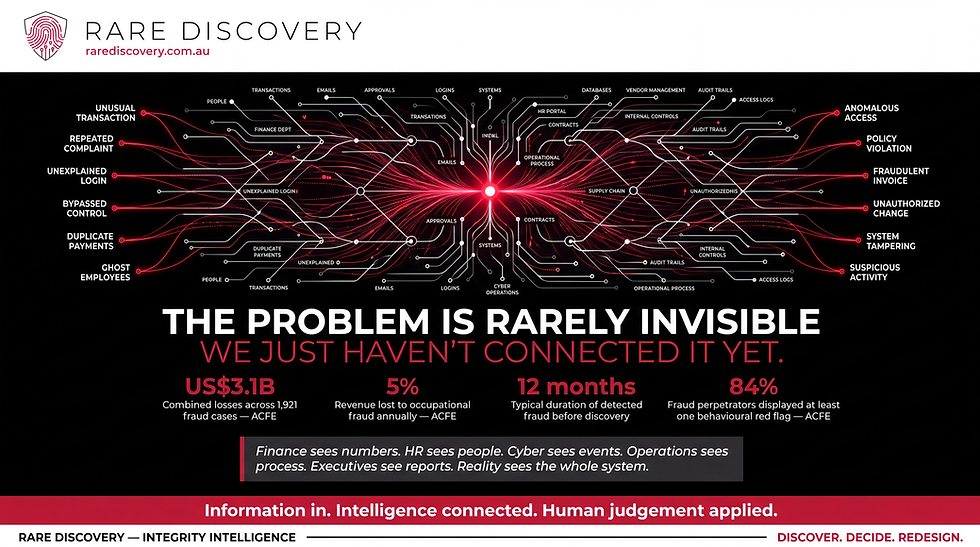
The Association of Certified Fraud Examiners estimates organisations lose 5% of annual revenue to occupational fraud. ACFE New Zealand’s NCSC recorded 5,995 cyber incidents in 2024/25, including NZ$26.9 million in reported direct financial loss. NCSC
But the numbers still understate the real exposure. They do not fully capture the employee who did not report, the customer who quietly left, the evidence that disappeared, the control exception that became normal, the board decision made from incomplete assurance, or the strategic opportunity missed while management was consumed by remediation.
The 2026 IBM breach research points directly to the new escalation: AI-driven attacks are up 56%, including deepfake impersonation and AI-enabled malware; the global average breach cost is now US$4.99 million. IBM
This should confront every board: AI is not arriving into a clean, fully governed operating environment. It is arriving into decades of accumulated permissions, technical debt, manual workarounds, fragmented data, inconsistent records and human pressure.
If those conditions are not understood, transformation can industrialise the weakness.
The board’s assurance problem
Most organisations still respond in silos.
HR investigates the conduct. IT remediates the fault. Cyber resets the account. Legal manages liability. Finance examines the transaction. A consultant writes recommendations. The board receives several updates and a reassuring statement that the matter is “under control”.
But no one has necessarily joined the evidence.
The people issue may sit inside Teams messages, access logs, delegated permissions, approval history, HR records, supplier data, deleted documents, device telemetry and an executive narrative. A cyber event may also be a governance failure. A bullying complaint may reveal suppression, conflicted authority, unmanaged workload and failing escalation pathways. A procurement anomaly may reveal a broader pathway of access, influence, weak segregation and untested exception handling.
The most expensive board mistake is accepting a partial answer as a complete truth.
A board should be asking:
What evidence proves the account we have accepted?
What permissions, workflows, systems or cultural conditions allowed this to occur?
Where else does the same pathway exist?
Which data, people or systems have not been tested because they fall outside a narrow investigation scope?
Could we show a regulator, insurer, court, funder or affected person a fair, lawful and defensible pathway from concern to finding to remedy?
If those answers are not clear, the organisation does not have assurance. It has a well-presented assumption.
Discovery before collapse
Rare Discovery exists for the hard space between “everything appears fine” and “the incident has become unmanageable”.
It is not another traditional investigation, cyber service, HR review or strategy report. It is an evidence-led discovery and organisational redesign capability: connecting fragmented signals across people, records, digital systems, authority, behaviour, access, workflow, controls and governance to establish the whole risk.
The purpose is not to produce a dramatic finding. It is to create defensible clarity:
what is happening;
what evidence supports it;
why it was possible;
where the wider pattern may sit; and
what must change before the next visible failure becomes consequential.
That work can be reactive after a serious event, preventative where controls are assumed rather than tested, predictive where weak signals are emerging, or transformative where AI, data and operating-model change are moving faster than governance.
Rare Discovery’s contribution is the disciplined conversion of organisational fragments into strategic state intelligence—so leaders can act on reality, not on the last report they received. It connects the human, technical and operational picture without reducing a complex issue to a single professional lens.
The underlying principle is simple: discover the truth, prove the pattern, protect the decision, redesign the system.
Protect the signal
The first sign of systemic risk is often held by one person: an employee, contractor, manager, customer or partner who has seen something others have missed.
If their only route is through the manager, process or power structure that may be implicated, the signal is easily softened, delayed or lost. Rare Protected Voice provides a protected, independent bridge for serious concerns to be received, understood and routed with care and discipline.
Rare Guardian extends that protection to people themselves: helping them recognise risk, preserve relevant information lawfully and navigate difficult situations from evidence rather than fear.
These are not peripheral features. In turbulent organisations, they are part of the sensing system.
The organisations that survive this decade will not be those with the most AI tools, the longest risk register or the most polished board papers. They will be those able to see the whole risk early enough to act—across people, technology, evidence and governance—before deterioration becomes destiny.
The question is not whether your organisation is changing.
It is whether you can still see what that change is doing to it.
Comments