
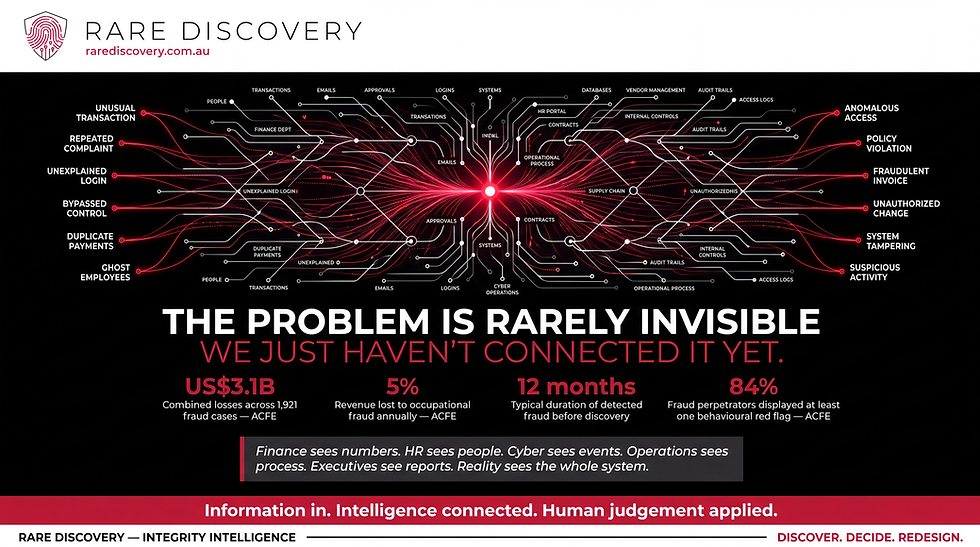
The Problem Is Rarely Invisible. We Just Haven't Connected It Yet.

Fraud. Misconduct. Control failure. Safety failure. Cultural failure. Digital risk.
They look different after the event. Before the event, they often look remarkably similar.
A strange transaction. An employee who keeps raising something. A control repeatedly bypassed. A customer complaint. A spreadsheet that doesn't reconcile. An unusual login.
A manager explaining away an anomaly. A resignation nobody connects to the next resignation. A digital trace sitting in one system while the explanation sits in another.
Nothing conclusive. Until suddenly it is.
The numbers should disturb every leadership team
The Association of Certified Fraud Examiners' 2024 global study examined 1,921 actual occupational-fraud cases across 138 countries and territories.
Combined losses: US$3.1 billion. Average loss: more than US$1.5 million per case.
Its fraud examiners estimate organisations lose approximately 5% of revenue to fraud each year. And the typical detected fraud had been operating for 12 months.
That last number matters. Twelve months of transactions. Twelve months of emails.
Twelve months of behaviours. Twelve months of approvals. Twelve months of digital evidence. Twelve months in which the organisation was generating information about its own problem. The problem existed. So did much of the evidence. What was missing was discovery.
Volkswagen is an uncomfortable case study
Volkswagen's diesel scandal eventually involved approximately 590,000 US vehicles fitted with software capable of cheating emissions testing. The US Department of Justice says the scheme stretched back years. Volkswagen ultimately agreed to plead guilty and pay US$4.3 billion in criminal and civil penalties. Yet this was not simply a machine malfunction.
Software was involved. Engineers were involved. Managers were involved. Regulatory interactions were involved. Testing results were involved. Documents were involved.
An external study eventually identified dramatically elevated real-world emissions; one tested vehicle emitted NOx at up to 35 times the allowable limit.
The strategic lesson is bigger than Volkswagen. Complex organisational failure can survive precisely because each participant sees only a portion of it. Technology sees transactions.
Finance sees numbers. HR sees people. Cybersecurity sees events. Operations sees process.
Legal sees liability. Executives see reports. Reality sees the whole system.
That is the discovery gap
Traditional investigations often begin after an organisation has already decided what kind of problem it has. Fraud goes to fraud investigators. Employment matters go to HR. Technology incidents go to IT. Cyber events go to security. Governance concerns go upward.
That structure is necessary. It can also be dangerous. Because the initial classification may itself be wrong.
A "people problem" may actually reveal control failure.
A financial anomaly may expose collusion.
A cybersecurity event may begin with human behaviour.
A procurement concern may connect relationships, payments, email and access records.
An apparently isolated complaint may be the fifth occurrence of a pattern nobody has mapped.
The most consequential problems increasingly live between organisational boxes.
Discovery therefore has to change
Rare Discovery was created around a simple mission: Discover what is actually happening before deciding what it is.
That requires a different investigative footing. Information is brought together. People, entities, documents, events, transactions, communications, relationships, systems and timelines can be correlated rather than examined as isolated artefacts. Our digitally empowered iGLUE™ approach uses AI and analytical methods to accelerate chronology, relationship mapping, anomaly detection, contradiction surfacing, evidence clustering and identification of gaps. But AI does not get the final word. That boundary is fundamental.
Machines can process extraordinary volumes of information. They cannot inherit accountability.
Technology accelerates discovery. Experienced humans retain judgement. Investigation still requires context, proportionality, fairness, scepticism, natural justice and the willingness to discover that the original hypothesis was wrong. Especially the last one.
Because investigation must not become prosecution by algorithm
Rare Discovery is interested in evidence for and against a proposition.
Exculpatory information matters. Alternative explanations matter. Context matters.
Missing evidence matters. The difference between correlation and causation matters.
The integrity of the outcome matters more than validating whoever commissioned the work.
That is why independence is not decorative. It is the product.
Think earlier
The most powerful investigation may be the one that prevents the "major investigation" ever becoming necessary. ACFE found 84% of fraud perpetrators displayed at least one behavioural red flag. Tips uncovered 43% of occupational frauds — at least three times more than any other detection method — and more than half of those tips came from employees.
Read those figures together. The signal is often already inside the organisation. The person may already know. The system may already contain the evidence. The transaction may already look wrong. The organisation simply hasn't connected them.
That changes the strategic question from: "How do we investigate what happened?"
to: "What could we discover before it becomes something much larger?"
That is a profoundly different capability. Reactive when necessary. Preventative where possible. Predictive where evidence supports it. Counter-anticipatory where somebody may deliberately be defeating the controls designed to find them. And emergent where new information changes the entire problem or direction itself.
The future of Board, CE, Leadership or organisational assurance will not belong solely to organisations with more dashboards, more data or more AI. It will belong to those capable of converting fragments into meaning — without losing human judgement, fairness or integrity along the way.
Somewhere in your organisation today there may be a number, behaviour, message, relationship or anomaly that means almost nothing by itself.
The interesting question is -
What happens when you connect it to everything else?
Rare Discovery™
Information in. Intelligence connected. Human judgement applied.
Comments